
You Don’t Have to Carry it All: Decluttering the Modern Man’s Mind

“Well… this is going to be an interesting week,“ I thought as I stepped into the sparse room where I would be staying for the next eight days. I had flown to Sedona, Arizona for a training in Internal Family Systems theory (IFS) which happened to take place at a retreat center out in the Sedona desert.
Unlike most modern hotel rooms, this room had no TV, no specialized outlets for charging cords, bare floors, and almost no décor. While it wasn’t Zen-style minimalist, it was definitely a change from our modern environments filled with distraction and decoration.
Over the week, however, I came to love it. I spent very little time in the room and more time out on the grounds of the retreat center exploring the desert when I wasn’t in class. When I returned to my room in the evenings, it was a welcome space of quiet and mental release.
Now, I’d be lying if I said I didn’t turn on my laptop and watch a video or two and catch up with friends on Discord chat. But the difference was that it was an intentional act rather than the default of checking out with distraction under the guise of “relaxation.”
Rather than losing track of time to YouTube or Netflix, the use of digital media was thoughtful and short-lived. The visual and mental quiet of the space invited me to read and rest.
When I returned home, I wanted to bring something of that experience with me. That started the move toward decluttering and minimalism I’ve been working on for the past year.
But what does this have to do with men and their mental health?
Just like how our homes can be cluttered with things we’ve accumulated over the years, our minds can be cluttered with thoughts, ideas, and beliefs we’ve acquired or been given by others.
Before we take a dive deep with that, let me give you a brief primer on minimalism and decluttering so you have an idea of where I’m coming from.
What Minimalism Is (and Isn’t)
You may have heard about minimalism and decluttering with shows like “Tidying Up with Marie Kondo.” Or perhaps you’ve come across mentions of minimalism on home shows, videos, or read one of the many books published in the past 10 years.
Minimalism as a pursuit is about taking the idea of “less is more” and removing things from our living spaces and lives that distract us from the what feels truly aligned and important to us. Decluttering is the process by which we sort, assess, and decide what to do with the things in our homes and lives.
From a practical perspective, it’s about taking stock of all of the things you’ve accumulated over time and deciding what you truly want to keep and what you’re just holding onto out of a sense of obligation, nostalgia, guilt, or what-if thinking like “I might need this someday.” This might involve getting rid of clothes you don’t wear anymore, furniture that doesn’t get used as anything other than a place to put other stuff, and items from hobbies you took up but never really stuck with.
Beyond the physical objects, it’s about removing those things from your life that feel burdensome, distracting, or otherwise create barriers to living a life that feels open, light, and aligned with who you are or who you want to be.
Minimalism isn’t about stripping your home and life down to the bare essentials and giving up everything that feels good and rewarding. It’s not about living like a Zen monk or only having so few things that you could live out of a backpack.
So, okay – enough of that. I can hear you saying, “This is great, Quinn… but get to the point.” Fair enough.

Mental Clutter and the Modern Man
Mentally, we all carry around a lot of things that take up space in our minds and create clutter that blocks us from feeling open and free to focus on the life we want to live and person we want to be. For men and masculine-aligned folks, there are a lot of messages around masculinity and things like success and strength that take up space in our thoughts. We stumble over them whenever we compare ourselves to others, feel pulled in directions that don’t align to societal norms, or experience life changes that throw our sense of identity into question.
These messages, rules, and identities might include things like:
A man must be strong, stoic, silent, and independent to the point that accepting help – let alone asking for it – is considered weak and unmanly.
Your worth comes from your income, output, and achievements.
What it means to be a “provider” and “protector.”
Social norms around emotional expression – especially around other men.
A man must always be in control. He must control the situation, the people around him, and his thoughts and feelings above all else.
A man must always be strong for others.
Let me be clear – there is nothing at all wrong with valuing strength, independence, and control. But these can also be taken too far.
Independence is a great value… until it becomes isolation.
Control is helpful… until it becomes constraint and dominance, affecting your relationships with others and even yourself.
Strength is useful… until it becomes a mask you wear to hide when you’re overwhelmed, burnt out, and struggling.
Mental decluttering isn’t about getting rid of everything you value about masculinity. It’s about getting rid of the things that either don’t serve you or changing how much of it you hold on to.
You can get rid of those 10 pairs of pants you never wear and keep those 5 pairs that you wear all the time. In the same spirit, you can learn that thoughts and feelings are notoriously hard to control while still valuing self-control in how you respond to them.
You Didn’t Choose Most of This
A lot of this didn’t start with you. It was handed to you with the expectation that you would keep these ideas for all time.
With physical decluttering, many people wind up with houses full of stuff they don’t want to keep but hold onto out of guilt, obligation, or expectation. They keep that dining set they never use because it’s gawdy yet feel bad about donating it because it was their grandmother’s. They hold onto that treadmill that they bought with good intentions because they feel guilty about taking the loss on something they “paid good money for.” Their closets are full of things that were given to them as Christmas and birthday presents that they’re afraid to toss for fear of upsetting the people that gave them those gifts.
In the same way, you were given ideas, identities, and messages about masculinity from others around you. You inherited them from your family, your culture, your religion, other men, or entertainment and social media. You may have even had to adopt some of them to mask things about yourself because of your sexuality, gender, or neurodivergence.
These ideas were handed to you, even pushed on you, and you were expected to take them, keep them, and make them part of you. They were never meant to be questioned. You were told it’s unmanly to even ask questions.
But it’s essential to ask questions.
Do these still belong in your life now? Which ones serve you well, align with what’s important to you, and create space and freedom in your life? Which ones don’t serve you, weigh you down, and create obstacles and problems for you?

Where to Begin
Watch any show or read any book on minimalism and decluttering and there is usually a process involved. Some experts go room by room, starting with the easier ones like bathrooms and living rooms first and moving to harder rooms like offices and closets later on.
Others take on clutter by object type. They might first start with furniture then move onto clothes. Books might be next. Photos and sentimental objects may be saved for later because they carry a lot of emotional weight.
Just like home decluttering involves a process, there is a process you can use for your inner world.
A Tool for Mental Decluttering: The ACT Bullseye
The ACT Bullseye helps you look at different areas of your life to determine where you are acting in line your values, the life you want to be living, or the person you want to be and where you are struggling. The version I’ve made available, which you can download in PDF format by clicking here, breaks it down into the following four broad domains of life with three sections each you can customize for things that are most relevant to you. The four main domains are:
1. Work or Education – Your Productivity Closet
This refers to your workplace, career, education, knowledge, and professional development. This may include a paid job, volunteer work, or unpaid labor such as your duties as a stay-at-home dad. You may also choose to include any other obligations that regularly take your time, such as caring for aging parents.
2. Leisure – The Space You Don’t Let Yourself Have
This domain includes things you do for relaxation, play, and enjoyment. This may be your hobbies, travel, vacations or “staycations,” reading for enjoyment rather than work/school or self-development.
3. Self-Development – Your Inner Sanctuary
Self-development includes the things you do for your mental and physical wellbeing such as diet, sleep, general personal health, exercise and movement (for fitness rather than leisure), counseling, and support groups. It may also include personal growth values like philosophy or spirituality.
It’s worth noting that “spirituality” does not necessarily mean religion. Rather, it can be anything that supports a feeling of connection to things greater than yourself, whether that’s humanity, the Earth, or the universe.
4. Relationships – Your Mental Living Room
This refers to the bonds in your life such as family, friends, community connection, and love and intimacy.
You might notice that some areas may overlap. For example, if you’re caring for aging parents, you may count that as “work” because it carries regular obligations. But you might also have a category under Relationships to evaluate how your responsibilities affect how close you feel with them.
Putting This Into Practice
To use this tool, look at the four domains (or your custom subsections) and place a mark closer to or farther away from the center based on how closely you feel you’re living aligned with what’s important to you.
If you feel very aligned, you’ll mark closer to the center.
If you feel like you’re very distant from what is important, you’ll place your mark closer to the outer edge.
For example, you might have a section for Family and one for Friends in the Relationship domain. If you have strong family ties but lack a friend group, you might be closer to the center for Family but in one of the outer rings for Friends.
Once you’re done placing your marks, look over your sheet to see what domains look like you’re living close to your ideal and which ones might need attention. The areas where you are farther from the bullseye may reveal where you’re carrying around a lot of mental clutter.
The image below provides an example of a completed ACT Bullseye.
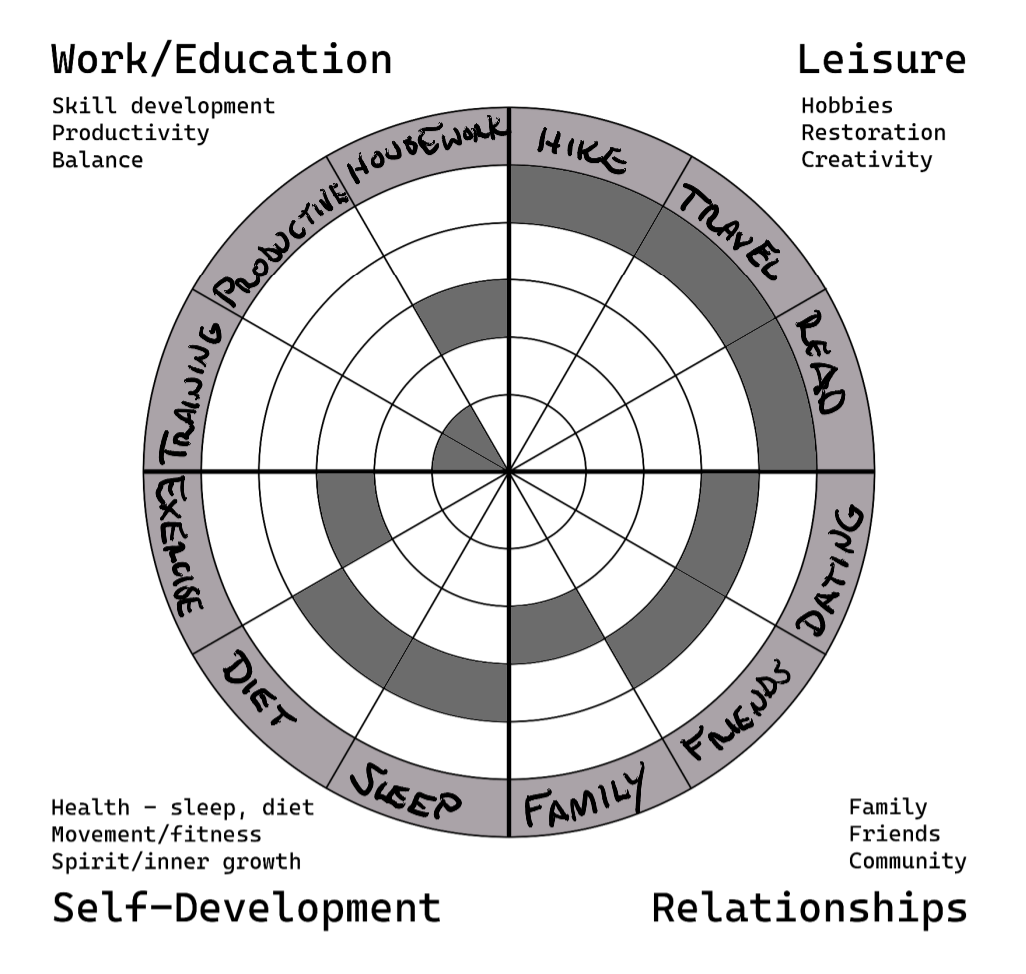
Example of a completed ACT Bullseye — Looking at this reveals the person believes they are doing well in terms of work productivity and training. On the other hand, they indicate that restorative activities like hobbies, their social life, and even diet and sleep are suffering. This might suggest they’re struggling with messages about masculinity that lead them to put a lot of emphasis on work and “success” as a measure of personal worth. This might show they’re headed for burnout.
Questions for Mental Decluttering
Now that you have your completed ACT Bullseye, look at the areas where you believe you are living close to your ideal and where you are farther away than you’d like to be. For those areas that you colored close to the center of the bullseye, consider if these align with your personal values or if they represent values you think you’re supposed to have.
For example, the person in the diagram above may believe they are on target with their professional life because they are carrying around messages about a man being “successful” based on his position, responsibilities, and income. On the other hand, they may truly love what they do for work but struggle to make time for friends and leisure activities because they fear that is being “selfish” or “unmotivated.”
For the areas where you are farther away than you’d like to be, consider what kinds of beliefs, ideas, or troublesome behaviors are keeping you from living in ways that are more aligned with how you want to act and who you want to be.
Here are just a few questions to help guide your reflections.
Work and Education
What are the definitions or expectations about success and career that you are holding on to that no longer fit who you are?
What parts of your work, education, or degrees still feel meaningful and what feels like clutter that you’re just keeping because you’ve put a lot of time and effort into them?
What are you afraid might happen if you let go of certain ambitions, roles, or expectations?
What about your work would you choose to change if you didn’t have to worry about anyone else’s expectations, opinions, or financial dependence?
Leisure
What beliefs do you have about productivity that feel like a burden – like you’re carrying around an extra suitcase of stuff when you go away on vacation or take a day off?
What activities do you hold on to that are more distraction or habit than actually restorative?
Where do you feel guilty about slowing down or “wasting time?” What does that guilt reveal about things you’re holding on to?
What things have you stopped doing that used to bring you energy or enjoyment because life became so cluttered with obligations and distractions?
Personal Growth
What ideas about the kind of man you “should” be are you holding on to without questioning?
What are you doing for personal growth that actually matters to you? What are the things you’re doing because you believed that’s what a man was supposed to do or value?
What ideas, values, and views have you inherited from your family, culture, or religion that no longer serve you?
What are you afraid might happen if you let go of those ideas, values, and views to make space for your own?
Relationships
What roles do you feel responsible for keeping in your relationships that you never consciously chose for yourself?
What ideas, patterns, reactions, or behaviors are you holding on to in your relationships that create distance rather than connection?
What ideas or beliefs are you keeping that prevent you from asking for support when you need it or the kinds of connections you desire?
What relationships are you holding on to that feel one-sided or draining instead of mutual and life-giving?

Making Space for What Actually Matters
Remember, minimalism and decluttering aren’t about getting rid of things for the sake of getting rid of things. They’re about removing the things that no longer serve you now, even if they served you at some point in your life, so you can focus on what is more important to you.
From a practical perspective, this might mean getting rid of that suit you used to wear to your first job because it literally does not fit you anymore.
But what does this look like mentally?
As you look at the different ideas and beliefs you accumulated over your life then start to discard what doesn’t serve you, you make space to focus on the ideas that do feel important to you. You also make room mentally to adopt new ideas and beliefs that feel more aligned with who you are and who you want to be.
Other ideas may not be discarded completely but held less intensely.
Just like that suit you’re tossing may not fit you anymore, you may have ideas about success and placing work above family that no longer fit you, either. Instead of climbing the corporate ladder and getting an ever-bigger paycheck, you may be making space to place value on having a good work-life balance. You may still value success, but choose to rate it by personal satisfaction over promotions.
This is just a small sampling of the kind of reflection you might do about what you are holding onto in your own mind and life. As you start to pay more attention to the ideas, beliefs, values, and behaviors you have inherited from elsewhere, ask yourself this question:
Does this still serve you, or does it create clutter?
Ready to Clear Some Space?
Need help with your own mental decluttering? I specialize in working with men struggling with overthinking and over-control who want to create the mental space to be themselves and live life on their terms. I offer in-person therapy in Northwest Arkansas and online counseling across the state. I invite you to use the link below to schedule a free discovery call to discuss the next step in your own inner decluttering journey.
Disclaimer: This article is for information purposes only and is not a substitute for therapy, medical advice, legal advice, or other professional advice. Always seek the advice of a qualified professional regarding questions about your own mental health, medical care, legal matters, or other personal circumstances. Every individual's circumstances are unique. Information that may be appropriate for one person may not be appropriate for another. Reading this blog does not constitute a professional-client relationship. While every effort is made to provide accurate and current information, no guarantee is made regarding the completeness, accuracy, or timeliness of the information provided. Any reliance on the information provided is solely at the reader's own risk. MoonPath Counseling, LLC and the author disclaim liability for any loss or damage arising from the use of this information.