
New Year, Same Frustration? A Therapist’s Tips for Men Who Want Real Change in 2026.

The New Year is hours away. Before you know it, January will be here and with it comes all of those New Year’s resolutions. This is a natural time to look back at where you’ve been, assess where you’re at now, and think about the goals and changes for the year ahead.
Unfortunately, very few Americans will make it far into the year with their resolutions intact. Research from 2024 shows that only 9% of people in the U.S. kept their resolutions through the whole year.
Of those who make resolutions, almost 75% of them will give up before the end of January. In fact, the second Friday of January is marked as Quitter’s Day in recognition that many people give up on their resolutions within two weeks of the start of the new year.
Why resolutions fail.
Studies and surveys reveal there are a few common reasons why this happens:
People feel pressured to make a resolution rather than personally wanting to change.
Their goals are too big or too vague.
They don’t develop a plan for change.
They take one slip-up as a sign of failure.
They don’t have any accountability.
There are many articles out there about these reasons and what you can do about them, ranging from downloading habit tracker apps to changing your home environment to support the change – such as tossing sweets and unhealthy snacks out of your cabinets to help with healthy eating. Of course, there are plenty of products out there that promise to be the one must-have item you need to finally make good on your resolutions! Just look at all of the diet supplements and flimsy fitness products set at the front of the stores like Target and Walmart after Christmas.
For many people, however, these aren’t enough. The usual tips, tricks, and gadgets still don’t help them stay on track past January. Why is that? Isn’t the will to change enough to do something that’s good for you?
Willpower alone will fail you.
Changing your life for the better isn’t as simple as making a resolution and sticking to it with sheer grit, determination, and willpower. We’d all be doing it if it were that easy and you wouldn’t be reading this article!
You’ve already seen the usual advice about SMART goals (Specific, Measurable, Attainable, Realistic, Time-bound), vision boards, accountability buddies, and journaling. You probably read most of those tips this time last year.
And the year before that.
And they year before that.
You probably clicked this article hoping for something different than what you found on the ten other sites you landed on before this one, so let’s dive into some of the things I’ve found helpful in my work as an Acceptance and Commitment Therapy (ACT) based clinical mental health counselor.

Tip 1: Link your resolution to a personal value.
ACT is all about values-based living.
The short version of ACT’s stance is we tend to thrive when we live in ways aligned with our values – even when we feel uncomfortable – and suffer when we are not aligned with our values.
If you value family and kindness but get short-tempered when under stress, you may react in ways toward your partner or kids that go against those values. You may yell or make biting comments that you later regret because you know you were not the kind, family-oriented person you want to be.
Values can also serve as a guiding vision that reaches beyond a simple goal or New Year’s resolution. In ACT, we often talk about this as “direction vs. destination.” For example, travelling west may be a direction that aligns with your values. Visiting Hawai’i would be a destination that can be part of your direction of “travelling west.”
Let’s say you’re one of the 8 in 10 Americans who will make a New Year’s resolution related to your health and fitness and make your goal, “I will go to the gym 3 times a week.” But it becomes apparent after a couple of months that going to the gym doesn’t fit into your lifestyle. After all, you not only have the actual time at the gym but you have to travel there, get dressed, do your workout or class, clean up, and travel home or back to work.
That’s a lot of time!
You start to fall short of your goal and decide to give up because going to the gym is just not workable and join the many Americans who give up on their New Year’s resolutions. But what if your resolution was based on a value like “healthier living?” What would be aligned with that even though you realized going to the gym wasn’t going to work? You might decide to:
Learn how to exercise at home
Take brisk walks during your lunch breaks
Join a yoga or martial arts class at a studio that’s much closer than the gym
Join a primal movement group at the park
You may notice that identifying a guiding value is very similar to another trend that has emerged in recent years. Namely, identifying a Word of the Year to guide you rather than making a specific resolution. The ideas are similar, but values have that extra element of being something you consider important deep within, not just as a good thing to do because everyone else is doing it.
There are a lot of values you might find personally important and many lists out there. Here are a few to help you get started. Rather than choose a bunch, you may find it easier to let just one be your guiding value for your resolutions.
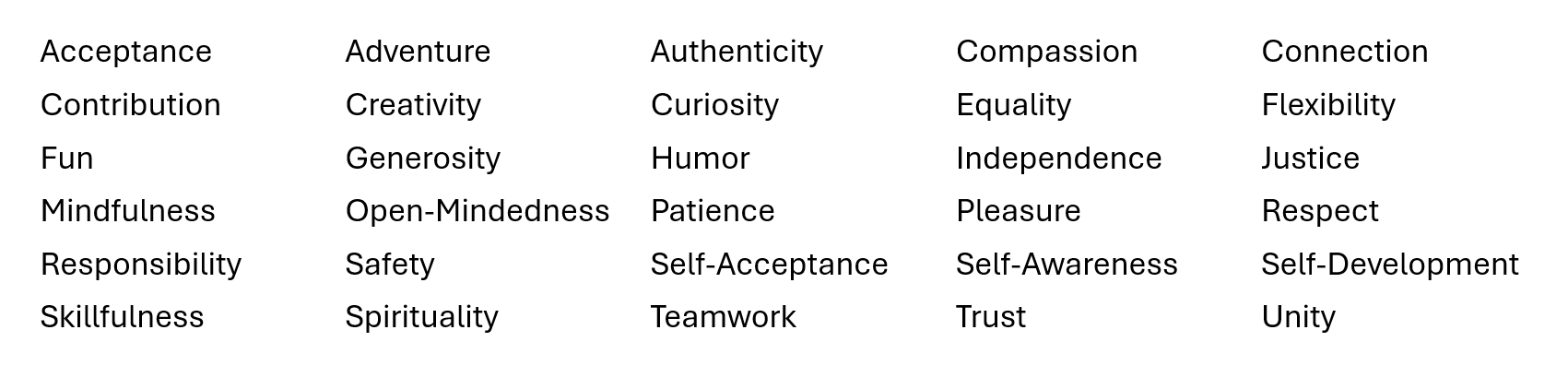
Tip 2: Be open to changing plans rather than giving up.
“Have a plan, but don’t be in love with the plan.”
The quote above comes from the psychology of wilderness survival and is another important part of ACT – psychological flexibility. Besides suffering when we don’t live according to our values, ACT maintains that being psychologically rigid and holding to rules like, “I must never feel anxious because that’s bad” or “I must always put on a brave face” also contribute to our suffering. By developing greater psychological flexibility, we improve our ability to adapt and change rather than getting stuck in our thinking.
Notice how the example above in Tip 1 demonstrated flexibility tied to values. In that example, the person who realized going to the gym wasn’t going to work didn’t abandon the spirit of their resolution and give up. They simply changed tactics.
While it’s true, the goal of “go to the gym 3 times a week” was released, the overall value of “healthier living” wasn’t. How the person continued pursuing that value simply changed to a different way of doing that.
It’s okay to have a plan, but it’s also okay to recognize when that plan isn’t workable and develop a new one. Being willing to do so is often what makes the difference in a survival situation and can make the difference in you improving your life in the coming year!
Tip 3: State your resolution as what you will do rather than what you won’t do.
Many people describe their goals in terms of negatives. That is, they state them as something they want to remove from their life. This might include statements like:
“I don’t want to be anxious.”
“I will stop smoking.”
“I’ll quit being so lazy.”
“I’ll stop letting my anger control me.”
But here’s the thing, your brain doesn’t understand negatives. It doesn’t understand “I don’t want this” or “stop doing that.” It’s not going to give up something just because you don’t want it to be a part of your life anymore. That’s one of the reasons making changes and sticking to resolutions can be so hard – you’re asking your brain to do something it can’t do.
So, what’s the alternative?
Flip the script and make your resolution something positive. Word it as something you want or will do more of. But how do you do that?
You need to give your brain something to replace the thing you don’t want. For example, if you look at my article on how I beat gaming addiction, you’ll notice I came up with a plan for what I would do instead of playing video games. And you can do the same.
Let’s look at the examples above.
“I don’t want to be anxious,” can be changed to, “I will learn 3 coping techniques for anxiety that I find helpful.”
“I will stop smoking,” might become, “I will join a support group to help me beat my smoking habit.”
“I’ll quit being so lazy,” could be reworded as, “I will begin folding and putting away my laundry as soon as I pull it out of the dryer instead of pulling clean clothes out of the basket all week.”
“I’ll stop letting my anger control me,” could be replaced with, “I will contact several therapists in my area to find one I feel good about working with.”
Basing your resolution on something you will do gives you a clear idea of what you want to work toward rather than away from. You can read more about that idea in my article, Get Off the Therapy Treadmill With Counseling that Focuses on Possibilities, Not Problems.
Tip 4: Have a relapse plan.
Have you ever heard the phrase, “Failure to plan is planning to fail?”
Well, when it comes to making change in life, “planning for failure is the plan for success.”
I know, it sounds counterintuitive but stick with me on this… because failure will happen. That’s no reflection on you. That’s just a part of the process.
Life is going to twist and turn and your resolution plans will encounter obstacles. You’ll get sick and stop going to the gym for a week. (Seriously, who decided the time for so many people to start crowding into a gym is a the height of cold and flu season?) You’ll go to a Superbowl party with all kinds of tempting food and break your diet. You’ll get stressed and snap at someone, breaking your kindness streak.
So, what are you going to do when that happens?
If you’re like many of the people making New Year’s resolutions, you probably can’t answer that. And that’s when the giving up starts. You fall off the wagon and decide you just weren’t meant to be healthier, kinder, or less distracted by social media.
Because you didn’t have your relapse plan.
A relapse plan is your plan for what you’ll do when, not if, setbacks or even exceptions happen. A relapse plan often includes 4 important parts.
Acknowledge what happened and how you feel. This can be hard, but it’s a powerful way to start getting back on track. You’re not going to make excuses - you’re going to accept the reality of the situation.
Unhook those thoughts and feelings. We often get tangled up in disappointment and self-blame when we feel like we messed up. Using the ACT tool of “Noticing and Naming,” you might say something like, “I notice I’m having the feeling of disappointment” instead of, “I’m such a disappointment.” You can read more about this in my article about Jedi Mind Tricks for Good Mental Health.
Recognize this was one setback, not total failure. A moment of relapse is just that, one moment in time. It’s just a brief blip in the overall process of change.
Seek the lesson. Reflect on what happened and see what you can learn from it. What were the circumstances leading up to the relapse? Was it a particularly stressful time? Do you need to learn some stress-management techniques? Could you benefit from a one-plate rule at the next sports party? Instead of seeing the setback as a total failure, treat it as a lesson you can use to do better in the future.
Bonus Tip: Don’t forget the compassion.
I want to stress the importance of giving yourself compassion through the change process.
I know it sounds “weak” to many, but it’s important to give yourself understanding when you’re struggling to make change in your life. You’re up against a lot, including possible pains from your past, old coping mechanisms that no longer serve you, and self-defeating thoughts and identities you carry inside you.
The change you want to make may not be as simple as applying pure willpower.
Our default when we struggle tends to be to get down on ourselves, because our brains think the way to motivate us is to make us feel bad about what happened, so we’ll change and avoid feeling bad in the future. I call this the “Drill Sergeant of the Mind.” It’s the part that will call you names and say things like, “You’re a loser” or “You’ve always been like this and you’ll always be like this.” Contrary to what the Drill Sergeant thinks, those thoughts don’t generally motivate us. In fact, they may stall our progress by making us feel worse.
Compassion, on the other hand, doesn’t mean you get a free pass. You do have to hold yourself accountable to doing the hard work, accepting the discomfort of change, and owning your choices that led to setbacks. But you can do so with the understanding that this is hard work.
Look at it this way – how would you talk to a friend if they told you they were really struggling with a change they resolved to make or shared that they had a setback? Would you insult them and try to motivate them by getting up in their face and yelling?
Or would you offer them understanding and cheer them on? Would you show them how far they’ve come and tell them you know they can keep going?
Can you offer that same compassion for yourself?

It’s a hard road ahead, but you can do it.
Change is hard, even when you really want to change in ways you know will improve your life. Staying values-focused and flexible, framing your resolutions as things you want more of rather than less of, and knowing how you’ll handle setbacks when they happen can help you stay the course in the coming year.
Acknowledge your wins and setbacks and use each one to learn more and refine the work ahead of you. Above all, give yourself the compassion that acknowledges you’re doing something difficult while also holding you accountable for actually taking action to make things happen.
What are your resolutions for 2026? Feel free to drop them in the comments below!
Need help making 2026 your best year ever?
Counseling doesn’t have to just be about treating anxiety or depression. A therapist who approaches counseling with a coaching edge can help support you in making the changes and improvements you want to make in life. Together, we’ll create a vision for what you want your life to look like using the tips covered in this article and more.
We’ll put the focus on what you want more of in life, help you gain the flexibility and skills needed to navigate the road ahead, and deal with setbacks when they happen to get you back on track.
Click the button below to schedule your free, 20-minute phone consultation or send me a message to find out more.
Disclaimer: This article is for information purposes only and is not a substitute for therapy, medical advice, legal advice, or other professional advice. Always seek the advice of a qualified professional regarding questions about your own mental health, medical care, legal matters, or other personal circumstances. Every individual's circumstances are unique. Information that may be appropriate for one person may not be appropriate for another. Reading this blog does not constitute a professional-client relationship. While every effort is made to provide accurate and current information, no guarantee is made regarding the completeness, accuracy, or timeliness of the information provided. Any reliance on the information provided is solely at the reader's own risk. MoonPath Counseling, LLC and the author disclaim liability for any loss or damage arising from the use of this information.